Renewable energy development is a feat of engineering at every level. Long before a turbine spins or a solar array energizes, hundreds of engineering decisions have been made about routes, loads, structures, soils, and systems. Most of those decisions happen quietly, in the background, handled by teams that never show up in a project ribbon-cutting photo.
At Logisticus, we’re one of those teams. And we think it’s time to talk about the engineering work we do every day that keeps renewable energy projects moving.
GIS as an Engineering Advantage
One of the fastest-growing capabilities in renewable energy logistics engineering is Geographic Information Systems (GIS). Our engineering team has been ahead of this curve, leveraging GIS data to support route analysis, site planning, and logistics coordination across wind and solar projects throughout North and South America.
GIS allows our engineers to do more than look at a map. We can analyze elevation changes, identify infrastructure constraints, assess bridge load ratings, and model logistics corridors before a single truck is dispatched. This translates directly into better permit packages, faster route approvals, and fewer surprises in the field.
When precision and efficiency are non-negotiable and in renewable energy, they always are – the ability to make data-driven engineering decisions before mobilization is a genuine competitive advantage.
What Over-Dimensional Engineering Really Involves
Most people understand that moving a wind turbine nacelle or a power transformer requires a big truck. What’s less understood is the engineering depth required to make that move safely, legally, and efficiently.
Here’s a sample of what our EOR team handles on a typical over-dimensional project:
- Route surveys and bridge analysis identifying load-critical crossings and calculating safe crossing weights
- Custom trailer configurations matching the right trailer combination to the load geometry and route constraints
- Turn drawings modeling turning radii at intersections and site access points
- Permit package preparation working with state DOTs to produce the technical documentation required for oversized load permits
- Lift and rigging plans engineered solutions for picking and placing components at origin, transfer points, and destination
- Lashing and securement drawings ensuring loads are documented and compliant with federal and state regulations
Each of these elements requires a licensed engineer who can put their stamp on the work. At Logisticus, that engineer is on our team – not a subcontractor we call when we need a signature.
Civil Engineering: The Site-Level Engineering Layer
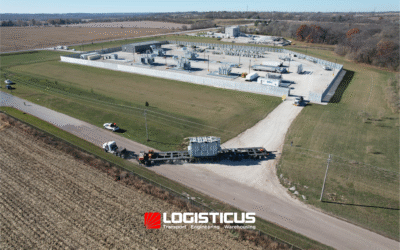
Beyond transportation, Logisticus Group provides civil engineering services that support renewable energy project sites directly. This includes design and construction oversight for lay-down areas, access roads, compaction specifications, geogrid solutions, and specialized storage infrastructure.
Our civil engineering capabilities are a natural extension of our logistics and project management work. When a project site requires a custom storage solution for a multi-year transformer hold as was the case with one particular project where our engineers designed it from scratch, built it to spec, and stands behind the structural integrity. That’s EOR-level accountability at the site level.
Why Integration Is Everything
The companies that build the best renewable energy projects aren’t just buying logistics and engineering separately. They’re looking for partners who can bridge the two, who understand the engineering requirements and the operational realities in the same conversation.
Logisticus was built on exactly that model. Our founders combined expertise in logistics, engineering, and technology because they knew the industry needed a company that could do all three together. More than a decade later, that integrated approach is what allows us to take on projects that other firms walk away from.
If your project involves:
- Oversized or over-weight components that require engineered transport plans
- Complex multi-modal logistics requiring stowage, lashing, or rigging engineering
- Site infrastructure needs – pads, access roads, containment solutions
- Projects where you need a single point of accountability for engineering and execution
…then it’s time to talk about Logisticus as your Engineer of Record.
The Bottom Line
Engineering in renewable energy logistics isn’t a back-office function. It’s a front-line capability that determines whether your project is delivered on time, within budget, and without incident. The companies that understand this and partner accordingly are the ones who move faster, take on more complex projects, and build reputations for delivering the extraordinary.
That’s what we specialize in. That’s what we’ve been doing since 2012. And that’s why we believe Logisticus Group belongs on your shortlist as the Engineer of Record for your next project.