The transformer is the one component your project can’t afford to lose. Getting it there is a project of its own.
Every power project has components that are big, expensive, and hard to move. The main power transformer is the one that can stop the whole project. It’s the piece that connects everything a site generates to the grid. It’s built to order, and it can take years to manufacture. When one arrives late or damaged, there’s no spare sitting on a shelf. The project waits.
That’s why moving a transformer isn’t a freight job. It’s a project of its own, with its own engineering, its own route, and its own risks.
Here’s what has to be gotten right.
Can the route carry the weight?
A main power transformer is among the heaviest single loads that travel on public roads. Every bridge, culvert, road surface, and turn along the way has to be checked against it, and the answer isn’t always yes. Sometimes a bridge needs to be analyzed or reinforced, a utility line raised, or the route redrawn entirely. That work has to happen long before the transformer leaves the factory, not once the truck is already moving.
Which way should it travel?
Long-distance transformer moves often combine ship, rail, barge, and heavy-haul truck, with a transfer between each one. Every handoff is a lift, and every lift is a chance for damage. The right plan matches the mode to the unit and the destination, and keeps the flexibility to change course if a lane closes or a storm hits.
Where does it wait?
Transformers rarely arrive the day the site is ready. The substation pad may not be finished, or the schedule may slip. Until then, the unit needs a place built for it: ground that can carry the weight, containment in case of an oil leak, power for any monitoring equipment the unit requires, and security around the clock. An open gravel lot is not the same thing.
How do you know it arrived intact?
Transformers are sensitive to impact. A hard jolt in transit can cause internal damage that can’t be seen from the outside but shows up in testing, or worse, once the unit is in service. That’s why every mile needs to be tracked and documented. If something goes wrong, you need to know where, when, and on whose watch.
Who gets it onto the pad?
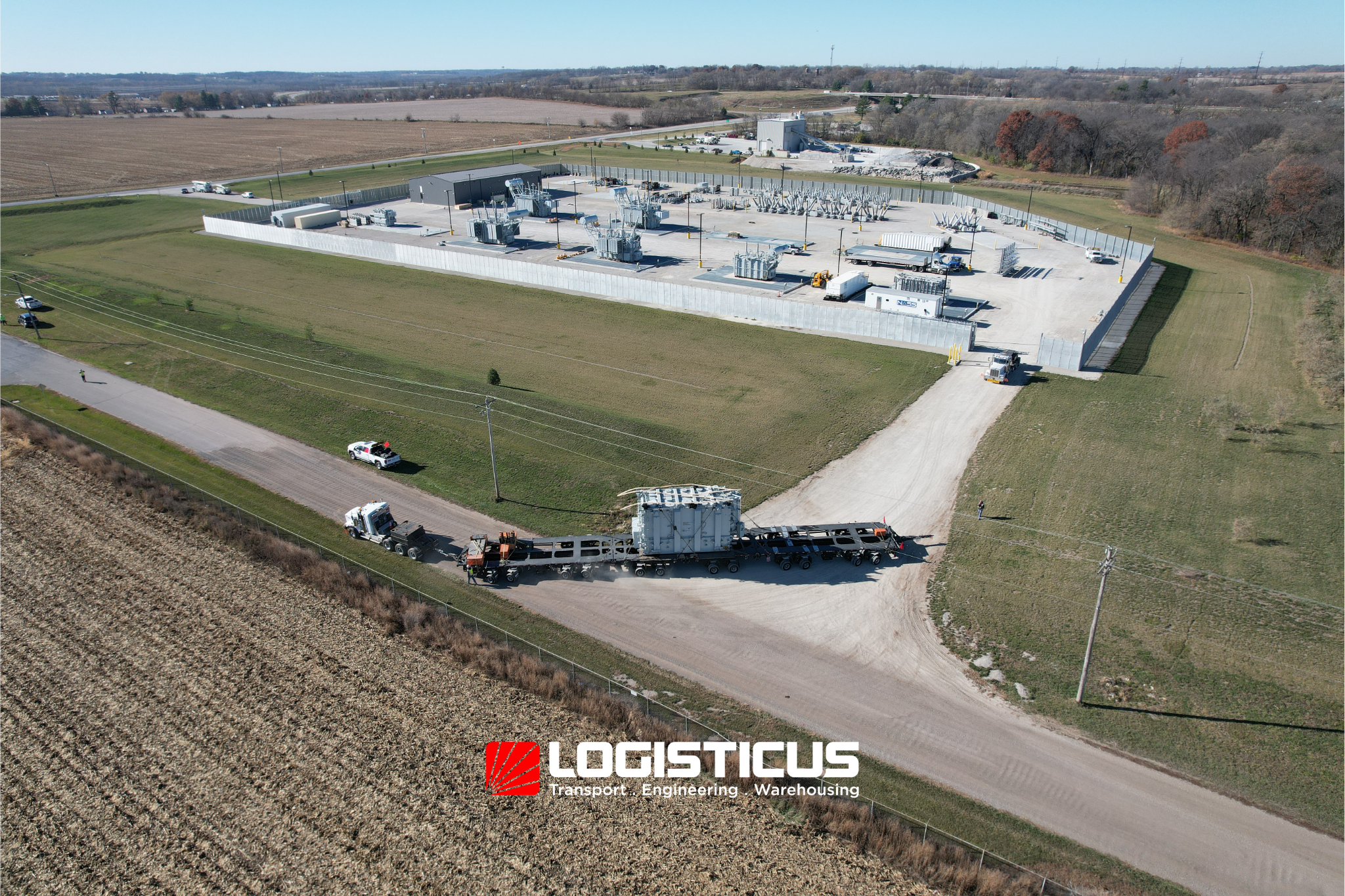
The final stretch, from the site entrance to the foundation, is often the hardest part. Site roads, soft ground, and tight clearances around the substation all have to be planned for, along with the equipment that sets the unit in place.
Why it can’t be solved in separate rooms
These questions depend on each other. The route decides which trailer you can use. The trailer decides how much weight lands on each bridge. Where the unit is stored decides what the last leg of the trip looks like. When engineering, transport, and storage are handled by different companies, each one hands its problem to the next, and the transformer absorbs the risk.
Logisticus brings all of it under one roof. Our engineers handle the pre-project analysis and route feasibility studies. Our transport team has moved transformers by truck, rail, and barge, including emergency barge moves after hurricanes and combined truck-and-rail moves through dense metro areas. We’ve stored main power components in 18 states, in gated, fully lit, and continuously monitored yards, with engineered features like custom oil containment designed around the unit. And our Logisticus Technology Solutions platform gives you GPS tracking, daily project updates, and a live dashboard from pickup to final set.
One team, accountable from the first route study to the moment the transformer is set on its pad.
Your transformer is the part of your project you can’t replace. Getting it there safely is the part we’d like to talk about.
Talk to our team before your transformer ships.