Every renewable energy project that involves heavy transport, complex lifting, or multi-modal logistics requires an Engineer of Record. That’s not a recommendation, it’s a reality built into permitting requirements, state regulations, and the basic standards of safe project execution. So the question isn’t whether your project has an EOR. It’s whether the one you have is positioned to actually protect your project or just positioned to sign the paperwork. There’s a significant difference between the two.
What the Role Demands
An Engineer of Record is a licensed professional engineer who assumes legal and technical responsibility for the engineering work on a project. They stamp the drawings, certify the calculations, and are accountable for the integrity of the design from planning through execution.
In the renewable energy space, that scope routinely includes:
- Structural analysis and custom pad design for heavy transformer or equipment storage
- Lift plans and rigging engineering for oversized wind, solar, or substation components
- Stowage and lashing plans for multi-modal transport across rail, barge, and truck
- Turn drawings and trailer configurations for over-dimensional loads
- Load path analysis and bridge studies for permit routing
Done well, this work is invisible, everything goes according to plan because the plan was right. Done poorly, it shows up as permit delays, field rework, insurance disputes, and in the worst cases, safety incidents. The stamp on the drawing is only as valuable as the judgment behind it.
The Problem With Engineering at Arm’s Length
The most common EOR failure mode isn’t incompetence, it’s distance. When engineering and logistics are managed by separate firms operating in separate lanes, gaps open up at every handoff. Drawings that don’t account for real-world trailer configurations. Lift plans developed without full knowledge of site constraints. Pad designs that don’t reflect actual equipment sequencing. These disconnects are more common than they should be, and they’re expensive when they surface in the field. An EOR who isn’t embedded in the operational plan is always working with incomplete information. They’re solving an engineering problem in isolation, without the context that comes from understanding how the load actually moves, where the constraints actually are, and what the field crew is actually going to encounter. That’s a structural problem and it doesn’t get solved by better communication. It gets solved by integration.
What Integration Actually Looks Like
At Logisticus Group, our engineering team is in-house. Not a preferred vendor, not a subcontractor we loop in at key milestones – our engineers work alongside our logistics coordinators, project managers, and field crews from the start of every project. The engineering informs the operations, and the operations inform the engineering, in real time.
That integration shows up in outcomes:
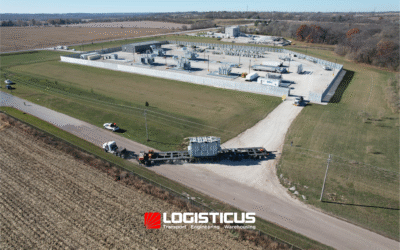
When a client needed compliant storage for a 350,000 lb, 285 MVA transformer, we designed and built a custom 500,000 lb-rated storage pad in three weeks including a 20,000-gallon oil containment solution at our Houston facility. Engineering and Operations were one conversation, which is why it happened on that timeline.
When four power transformers failed simultaneously across South Texas, we mobilized quickly, managed TxDOT permitting and bridge studies, and executed full electrical undressing and redressing on units ranging from 200,000 to 350,000 lbs. Having our engineers embedded in the response meant decisions were made faster, with full situational awareness, not across a coordination gap.
For FEMA’s Hurricane Maria response, our engineers developed the barge stowage and lashing plan to move 112 utility trucks to Puerto Rico contributing to power restoration for more than 400,000 residents within six weeks of landfall. That kind of timeline requires engineering and logistics to operate as a single function.
The Standard Worth Holding Your EOR To
As renewable energy projects grow in scale and complexity larger components, more remote sites, tighter permit timelines – the demands on the EOR role grow with them. A stamp on a document isn’t enough. What projects need is an engineer who is close enough to the operation to catch problems before they reach the field, and experienced enough to make smart decisions under real-world pressure.
That’s the standard Logisticus holds itself to on every project we take on. If you’re evaluating your current EOR relationship or building the team for an upcoming project we’d welcome the conversation.